Education, behaviour, AI, climate change and economic opportunity.
JOB MARKET PAPER · 2026–2027
Blindsided at the Start: Small Early Shocks and High-Stakes Selection
with Yi Chen, Sikun Dou and Hongbin Li
How do small, unexpected early shocks propagate through high-stakes selection? Using administrative records for 13.6 million Gaokao candidates and LLM-based measures of question difficulty, we study the consequences of an adverse start. Estimated score losses exceed the first question’s own scoring weight and differ across school backgrounds, showing how limited formal stakes can translate into larger and unequal performance losses.
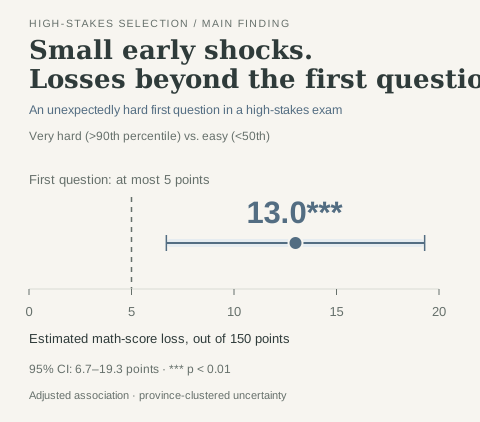
An unexpectedly hard opening is associated with an estimated 13-point loss in total mathematics scores, relative to an easy opening. The first question itself is worth at most 5 points, suggesting effects beyond its direct scoring contribution.Extreme: above the 90th percentile of opening difficulty; easy: below the 50th. Error bars show the 95% confidence interval; *** p < 0.01 for the extreme-versus-easy comparison. Source: November 2026 job market talk and paper, Table 14.
A central question in institutional design is how formal rules translate into realized economic outcomes. We examine this question in high-stakes selection, distinguishing the first question’s formal scoring contribution from its wider influence on performance.
Combining administrative records for 13.6 million candidates in China’s National College Entrance Examination with GPT-4o-based difficulty measures for 484 mathematics questions from 22 examination sets, we exploit variation in opening difficulty across administratively assigned papers, conditional on measured aggregate difficulty, province and year fixed effects, and individual characteristics.
A one-standard-deviation increase in opening difficulty is associated with a 6.4-point decline in mathematics scores. This point estimate exceeds the item’s maximum five-point value, suggesting effects beyond its direct scoring contribution. Students from high schools with stronger first-tier university admission records incur smaller losses.
When applications are submitted before the examination, this differential extends to relative rank, with suggestive evidence that the STEM university placement gap among admitted students widens by 1.4 percentage points in their favor. Patterns across examination contexts and task content are consistent with expectation-based salience against a familiar easy-start convention, potentially operating through cognitive interference.
The findings suggest that individual responses can give a component with limited formal scoring stakes wider influence over high-stakes selection.
Selected presentations
Labour Reading Group, University of Cambridge · Empirical Brown Bag and Micro Brown Bag, LMU Munich
Scheduled: Inaugural IZA@LISER Conference in Labour Economics · Guangzhou Workshop for Early-Career Applied Economist, Jinan University · BeNA Labor Economics Workshop, Freie Universität Berlin
WORK IN PROGRESS
Playing it Safe: How Conservatism Shapes the Gender Gap in High-Stakes Decisions
with Yi Chen, Sikun Dou and Hongbin Li
We study gender differences in university choices in China’s Gaokao, examining the costs and benefits of conservative choices and how reduced uncertainty changes these gaps.
A large body of laboratory experiments has confirmed that women are more risk-averse than men. However, less is known about the real-world costs and benefits of being cautious. We explore this question by examining gender differences in school choices during the Chinese College Entrance Examination (Gaokao) in the early 2000s. During our study period, China employed a sequential admission mechanism, making the choice of a first-batch first-preference school particularly risky.
If a student narrowly missed the cutoff for that school, they faced a high likelihood of being placed in a significantly less desirable school. We find consistent evidence that female students were more likely to avoid this risk by selecting a more conservative option as their first-preference choice. This strategy involves both costs and benefits. On the benefit side, given their test scores, female students were less likely to fail their target schools compared to male students.
On the cost side, however, they were more often admitted to lower-quality schools and less desirable majors. These gender differences remain robust across a range of checks, including controls for preferences toward specific majors and types of schools. To further validate that these patterns are driven by differences in risk aversion, we exploit policy shifts in the timing of preference submissions—from before to after exam results were known—which reduced uncertainty. We find that reduced uncertainty narrows the gender gap across various outcomes.
Presented at: 8th China Center for Economic Research Summer Institute (2024); EEA–ESEM, Rotterdam (2024); International SITES–GLO Conference (2024); AIEL–DSE Workshop (2025, poster session).
Seeing Climate Change: Emotional Visuals, Attention, and Pro-environmental Behaviour